Since 2014, I’ve had the privilege of serving as a judge for the Constructing Excellence in Wales (CEW) Awards — evaluating projects competing for the most prestigious recognition in Welsh construction. Over more than 10 years, that has meant reviewing over 100 submissions, representing more than £5 billion of collective project value. No spoilers for this year’s Awards — but the dataset already tells a compelling story.
These aren’t abstract numbers. Behind each application is a team that believed their project was worth celebrating — and was willing to open it up to scrutiny. That takes confidence, and it’s something I’ve always respected about the CEW Awards process. Each year culminates in the Awards dinner — held at the Celtic Manor in Newport — where the best of the best are celebrated in front of hundreds of industry peers.
The breadth of what gets built in Wales
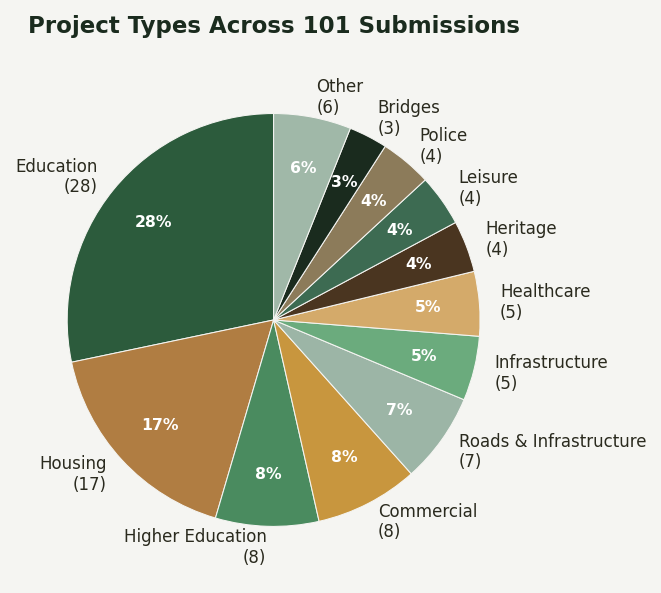
The range of projects submitted reflects the diversity of the Welsh built environment. Submissions have included landmark pedestrian bridges and major trunk road upgrades, schools and universities, hospitals and care homes, police custody suites and community hubs, heritage restorations and semiconductor manufacturing facilities.
From the Pont y Ddraig lifting bridge in Rhyl to the A465 Heads of the Valleys dualling, from Fitzalan High School in Cardiff to the Severn View Park Care Home in Chepstow — the spectrum runs from intimate community projects of a few million pounds to national infrastructure programmes exceeding £1 billion.
Who’s doing the work
Certain names appear repeatedly across the years, reflecting the strength of Wales’ established contractor base. Kier Construction, Castell Group, Bouygues UK, Willmott Dixon, and Andrew Scott Ltd have all featured prominently. The nominated SMEs — a compulsory part of each entry — have consistently highlighted the depth of specialist capability across the Welsh supply chain.
On the design side, it’s notable how many Welsh-headquartered practices appear across the submissions. Powell Dobson Architects feature in entries spanning police facilities to schools. Rio Architects have been behind several landmark Cardiff projects including One Central Square and the Royal Mint Experience. Pentan Architects designed the Severn View Park Care Home — one of the highest-scoring entries in recent years. Holder Mathias delivered the Castle Quarter regeneration in Swansea. Stride Treglown, with their significant Cardiff office, appear in four separate entries. This is home-grown Welsh design talent delivering at the highest level — something for the Royal Society of Architects in Wales to be proud of.
Carbon: from afterthought to centrepiece
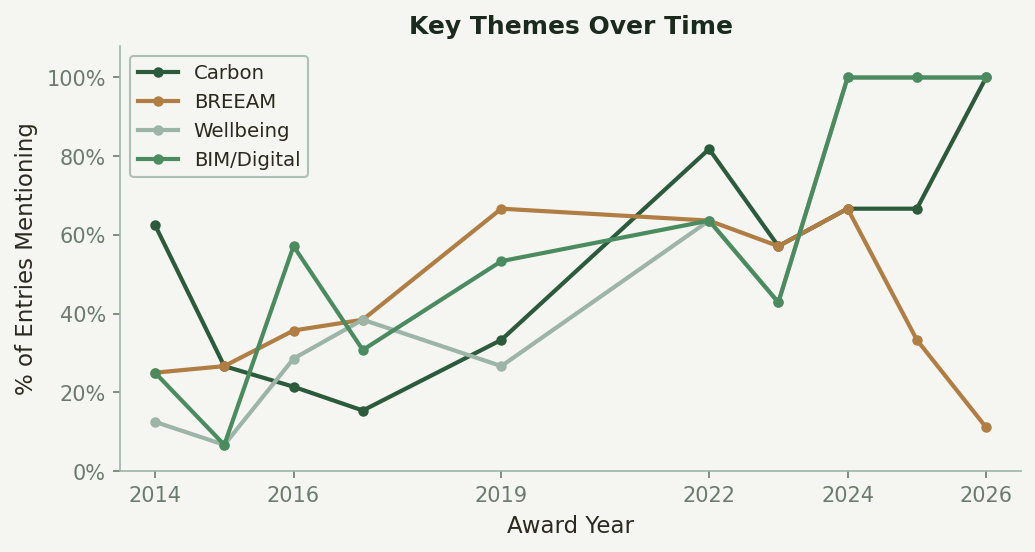
In the earlier years, sustainability was one category among several — something projects might mention in passing. That has fundamentally changed. 47 of the 101 submissions now reference carbon, with 30 specifically addressing carbon reduction or carbon footprint strategies. 12 projects discuss embodied carbon — the emissions locked into materials and construction processes, not just operational energy.
Net zero has emerged as an explicit target in 8 projects, all from 2022 onwards. 11 projects describe themselves as zero carbon or carbon neutral. BREEAM assessments feature in 43 submissions, with 22 achieving Excellent and 5 achieving Outstanding. Renewable energy systems — solar arrays, heat pumps, photovoltaics — appear in 44 of the 100 submissions.
The most recent cohort almost universally addresses carbon in detail. This is genuine progress, not just better marketing — and it reflects a Welsh construction industry that has moved from aspiration to measurement.
Community runs through everything
Perhaps the most consistent thread across all years is community engagement — 80 of the 100 submissions reference it directly. 42 projects have provided apprenticeship opportunities, a figure that has remained remarkably consistent from 2014 onwards. 31 have explicitly targeted local employment and local labour, and 25 have participated in the Considerate Constructors Scheme. 9 projects describe specific school visit programmes or STEM ambassador engagement.
Where projects report specific apprentice numbers, the data suggests roughly 1 apprenticeship per £1.5 million of project value — though this varies enormously. Smaller community-focused projects tend to punch well above their weight: the £6.5m STAR Community Hub reported 137 apprenticeships, while the £321m A465 Heads of the Valleys reported 69. Scale doesn’t automatically mean greater social return.
Social value — once an afterthought — is now a formal scoring criterion, and the depth of evidence submitted has grown substantially. What started as a line about hiring local subcontractors has evolved into structured programmes with measurable outcomes: hours of training delivered, pounds spent within a given radius, career pathways created. The best submissions don’t just report these numbers — they explain why they matter.
Safety as a baseline, wellbeing as the new frontier
Health and safety is referenced in the majority of submissions, and 11 projects have reported zero accidents or zero harm across their entire construction programme. But what has changed most visibly is the broadening of “safety” into “wellbeing”. In 2014, just 1 submission mentioned wellbeing. By the most recent complete year, almost every entry does. Mental health is now explicitly addressed in 19 projects. The conversation has shifted from hard hats and harnesses to mental health first aiders, equality and inclusion strategies, and genuine cultural change. The industry’s understanding of what “safe” means has visibly matured.
Digital tools, BIM and the emergence of AI
Building Information Modelling has become part of the furniture. 39 of the 101 submissions reference BIM, and that number has been consistent since 2016 — it’s no longer a novelty, it’s an expectation. Autodesk Revit is the most frequently cited platform, appearing in 12 submissions, often paired with Navisworks for clash detection and coordination. Synchro — Bentley’s 4D construction planning tool — features in several of the larger infrastructure projects. For common data environments, Viewpoint and Aconex appear across multiple entries, with newer platforms like Procore and Dalux emerging in the most recent submissions.
Beyond the core BIM platforms, it’s the more innovative tools that tell the real story. Matterport 3D reality capture and HoloBuilder 360-degree site documentation are appearing in recent entries. Pix4D photogrammetry featured at Fitzalan High School for drone-based survey mapping. On the environmental side, One Click LCA — a whole-life carbon assessment tool — appeared in a 2026 submission, and SmartWaste is being used to track and reduce construction waste. The concept of the Golden Thread — a continuous digital record of building information required under the Building Safety Act — is referenced in 18 projects, all from 2024 onwards.
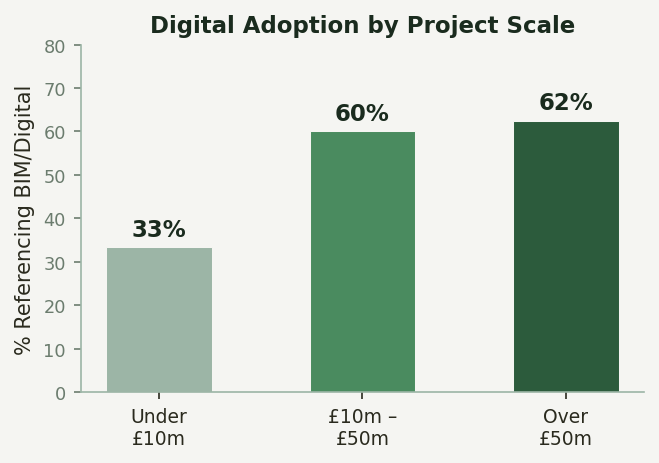
There’s a clear correlation between project scale and digital adoption. Among projects under £10m, only a third reference BIM or digital tools. Between £10m and £50m, that rises to 62%. Above £50m, it’s the same 62% — suggesting the tipping point is around the £10m mark, after which digital is effectively standard practice regardless of how large the project gets.
AI is only just beginning to appear — referenced in just 2 submissions so far. But given the pace of change, I’d expect that number to look very different by 2028. The trajectory from hand-drawn score sheets (which I was still using in 2014) to structured digital evaluation is itself a reflection of how the industry has moved.
How projects are delivered
The NEC family of contracts dominates. Across the submissions where contract form was identifiable, NEC3 and its successor NEC4 were overwhelmingly the most common procurement routes. JCT appeared occasionally, typically on smaller or more traditionally procured projects. This aligns with the Welsh Government’s longstanding preference for NEC as the standard form for publicly funded work, and it’s a trend that has only strengthened over the decade.
What judging teaches you
Reviewing 100 projects across a decade gives you something that individual project experience cannot: perspective. You see which innovations actually stuck and which were one-off experiments. You see which contractors consistently deliver and which teams elevate a project beyond its brief. You see how the questions the industry asks of itself have evolved — from “was it on time and budget?” to “did it leave the community better off?”
The CEW Awards process works because it demands evidence, not assertion. Every claim must be supported. Every innovation must be explained in practical terms. It’s a rigorous process, and the projects that succeed are the ones where every team member — client, contractor, consultant, and supply chain — has genuinely collaborated to deliver something they can all be proud of.
I hope to be asked to carry on judging for many years to come. And maybe the next blog should be “how to write an award-winning application…”